Simplifique el paletizado con sistemas automatizados.

Siempre que puede eliminar un cuello de botella en las operaciones de su almacén o centro de distribución, es una victoria. Ahí es donde entran los paletizadores, que aceleran una de las etapas donde los retrasos son más propensos a ocurrir.

Piense en ellos como un lubricante para la carga y el apilamiento de palés.

Además de ser un proceso intensivo en mano de obra, la carga manual de palés también puede generar ineficiencias, incluidas cargas inconsistentes y mal equilibradas. Las cajas mal apiladas aumentan aún más el riesgo de daños al producto y de accidentes laborales.

La carga manual de palés también puede provocar lesiones por movimientos repetitivos en los trabajadores. En un momento de costos laborales crecientes y dificultad para encontrar empleados calificados, la paletización manual consume tiempo y recursos valiosos que podrían aprovecharse mejor en tareas de mayor valor que requieren experiencia humana.

Los paletizadores automatizados abordan estos desafíos aumentando la eficiencia, produciendo cargas paletizadas estables y uniformes, maximizando el espacio disponible en el almacén y reduciendo las exigencias físicas sobre su personal.

Paletizadores Automatizados: ¿Cómo Funcionan?

Los paletizadores automatizados utilizan tecnología inteligente para optimizar el apilamiento, determinando los patrones de capa ideales según el tamaño y las dimensiones de cada producto. Cargan las cajas en cada palé de forma rápida y eficiente, girándolas según sea necesario. Esto no solo ahorra tiempo, sino que también garantiza la consistencia de los patrones de paletización.

Así se ve el flujo de trabajo con un Paletizador Qimarox HR9:

Cuando llegan nuevos productos a su instalación, los miembros del equipo los cargan en un transportador.
A medida que los productos avanzan por el transportador, un escáner 3D mide las dimensiones de las cajas.
Un generador de patrones calcula todas las combinaciones posibles y sugiere la disposición ideal para el palé, según el número óptimo de cajas por capa y la estabilidad general.
Conforme las cajas llegan al paletizador, se organizan automáticamente sobre el palé.
Los paletizadores pueden combinarse con un elevador de palés y un sistema transportador, de modo que cada palé completo se apile y sea reemplazado automáticamente por uno vacío, logrando un proceso continuo y sin interrupciones.
Los productos pueden asegurarse sobre el palé según sea necesario, quedando listos para su transporte mediante montacargas.
Cuando el contenedor está vacío y se ha cargado el último palé completo, los productos restantes pueden apilarse en un palé incompleto.

Beneficios Que Se Acumulan

Los paletizadores de última generación son rentables y están diseñados para el manejo seguro de productos en alto volumen. Los beneficios incluyen:

Flujo de trabajo más fluido: los paletizadores automatizan el proceso de paletización de principio a fin, desde la alimentación hasta el despacho.
Calidad de carga más consistente: los paletizadores crean patrones de carga uniformes con mayor estabilidad, lo que reduce los daños al producto durante el almacenamiento y el transporte.
Mayor throughput: el manejo más rápido de los productos, con cargas paletizadas más estables y consistentes, ayuda a las operaciones a seguir el ritmo acelerado de las demandas de producción.
Mayor seguridad laboral: los paletizadores minimizan los movimientos repetitivos de levantamiento y flexión, lo que reduce el riesgo de lesiones musculoesqueléticas y crea un entorno más seguro al final de la línea.
Eficiencia de mano de obra: la menor dependencia del apilamiento manual no solo significa menos desgaste para los miembros del equipo, sino que mejora el aprovechamiento del personal, liberando a los empleados para que usen mejor su tiempo y talento. También reduce las tasas de error e incrementa la previsibilidad operativa.

Los paletizadores generan retorno en múltiples industrias.

Fabricantes: manejo de productos terminados y automatización de la línea de producción
Distribuidores: cumplimiento de pedidos en alto volumen y mejor preparación para el envío
Bienes de consumo: manejo de productos variados
Alimentos y bebidas: entornos de empaque de alto throughput
Alimentos refrigerados y congelados: reducción de los tiempos de transporte, ayudando a evitar la descongelación y a mantener la calidad de los productos

Qué Distingue a los Paletizadores Qimarox

Ultimation ofrece paletizadores Qimarox de alta capacidad para:

Manejo automatizado de productos. El método patentado de formación programable de patrones de Qimarox posiciona los productos en coordenadas exactas para optimizar el espacio de almacenamiento y de transporte.
Posicionamiento más inteligente. Los productos se disponen sobre los palés con un espaciado ideal para absorber deformaciones y ayudar a prevenir daños. Esto garantiza que los palés completamente cargados sean no solo estables, sino también sólidos.
Creación flexible de patrones de paletización. El Qimarox Highrunner HR9 le permite elegir entre generar automáticamente los patrones de capa más adecuados para sus productos o seleccionar la disposición de su preferencia.
Los paletizadores Qimarox están diseñados para manejar diferentes tamaños de empaque y tipos de producto.
Manejo superior de productos. Los paletizadores Qimarox no solo apilan los productos de forma segura y consistente, sino que los deslizan sin levantamiento manual ni robótico para minimizar los daños.
Mantenimiento más sencillo. La tecnología Qimarox facilita el trabajo de los mecánicos, con sistemas de cámaras integrados que ayudan a identificar y resolver problemas rápidamente.
Para operaciones en crecimiento, las soluciones de paletización Qimarox escalan para asumir nuevos desafíos según sea necesario.

Cuándo Considerar un Paletizador para Sus Operaciones

Si está experimentando alguna de las señales siguientes, su operación puede estar lista para un paletizador automatizado:

Aumento en el volumen de pedidos. ¿Necesita incrementar su throughput para mantenerse al ritmo de la demanda?
Cuellos de botella frecuentes. ¿Su línea de producción se ralentiza con frecuencia en la etapa de paletización?
Preocupaciones de personal. ¿Enfrenta costos laborales crecientes o dificultad para reclutar y contratar trabajadores de almacén con el nivel adecuado de habilidad y experiencia?
Problemas de seguridad. ¿Observa un aumento de lesiones, estrés y fatiga entre los miembros del equipo debido al manejo manual?

Cómo Elegir la Solución de Paletización Correcta

Aquí hay cuatro criterios clave a considerar que pueden orientarlo en la dirección correcta.

Requisitos de throughput. ¿Cuál es el volumen de productos que maneja actualmente? ¿Cuánto necesita aumentar su capacidad?
Características del producto. ¿Qué tan variables son los productos de su almacén en cuanto a peso y dimensiones? ¿Qué requisitos especiales tienen? ¿Qué tan importante es la velocidad de procesamiento?
Limitaciones de espacio de la instalación. ¿Qué tan restringido es su espacio de piso y está aprovechándolo de la mejor manera posible? ¿Se beneficiarían sus operaciones de una distribución de producción más eficiente?
Crecimiento futuro. ¿Para qué oportunidades necesita estar preparado? ¿Qué posibilidades puede abrir para su negocio el aumento del throughput y el mejor uso de recursos como el espacio y la mano de obra?

La solución de paletización correcta puede transformar sus operaciones, haciéndolas más flexibles y adaptables, además de impulsar la seguridad, la eficiencia y el throughput.

¿Le interesa saber más sobre las soluciones de paletización Qimarox? Póngase en contacto con nuestro equipo.
 

How Spring-Assisted Lift Gates Remove Barriers to Productivity

Looking to safely improve warehouse efficiency? Learn how spring-assisted…

Do More With Your Warehouse Space with Powered Flexible Expandable Conveyors

Both time and space are at a premium in warehouse facilities.

That’s why flexible expandable conveyors are a valuable solution. Like a sofa that pulls out, flexible expandable conveyors expand when you need them and compact when you don’t. This adaptability makes them a cost-effective way to streamline assembly, packing, shipping, and receiving — especially for warehouses that deal with a lot of cross-docking, loading, and unloading.

But as useful as traditional gravity-based flexible expandable conveyors already are, there’s a way to make them even better: power. The powered version of flexible expandable conveyors delivers benefits that can reduce labor while simultaneously boosting efficiency and throughput.

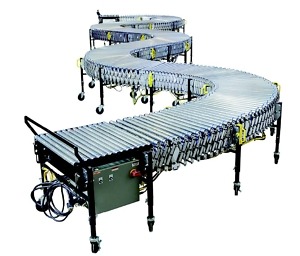
How Adding Power Multiplies FlexibilityULTIMATION Powered Flex Conveyor

Powered flexible expandable conveyors are designed to adapt to your operation in real time.

  • Expands from 3 to 12 feet
  • Bends easily around obstacles and tight spaces
  • Connects seamlessly with additional conveyor units
  • Mounted on casters for easy mobility and positioning

This flexibility allows you to position one end near storage racks and the other at a truck or van for efficient loading and unloading. You can also use them to move products directly from one truck to another.

Because they’re compact when collapsed and quick to deploy, these conveyors can be rolled into place as soon as shipments arrive and then stored away when not in use.

Traditional gravity conveyors still require manual effort and often depend on an incline, making them more labor-intensive. By contrast, powered versions don’t require an incline so they can be deployed anywhere on your floor. Simply roll them into position, plug them in, and let them move product automatically – reducing effort, increasing speed, and improving overall efficiency.

Gravity vs. Powered Conveyors

The advantages of powered flexible expandable conveyors include:

  1. Ease of Use. Powered flexible expandable conveyors feature simple deployment; it only takes one person to set up a conveyor and move it into position. Operating them is similarly easy, with minimal manual handling.
  2. Reduced Labor. That ease of use means that one person can do the same work as three to four people using a gravity conveyor, which multiplies productivity.
  3. Better Ergonomics. By reducing the effort needed, powered flexible expandable conveyors reduce the risk of injury to workers, while also promoting more efficient handling and less chance of damage to products.
  4. Increased Throughput. With more efficient loading and unloading, powered flexible expandable conveyors move more product with less effort, which increases productivity.

A Smaller Footprint

The ability to scale up and scale down in response to changing circumstances has never been more important than it is today. With ongoing labor shortages and rising costs, warehouses are under pressure to do more with fewer workers.

Any innovation that provides warehouses with a way to adapt quickly and efficiently is a boon. Adding power to flexible expandable conveyors means you can get more out of your available warehouse space, without increasing the footprint.

Ready to reduce labor and increase throughput? Contact the team at Ultimation, an MCE company, to speak with a conveyor expert or request a quote.

How VectoRollers™ Boost Efficiency and Reduce Friction to Create a Flexible Flow in the Warehouse

Some ideas are so good for flow, they seem inevitable in retrospect. This is especially true if they apply a little out-of-the-box creative thinking to a long-standing pain point

— like luggage with wheels or self-sealing envelopes.

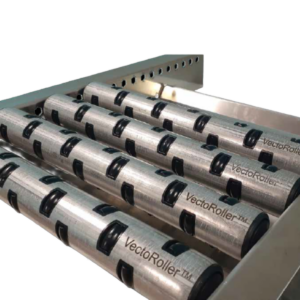
VectoRollers Installed in Gravity Conveyor

For warehouse conveyor systems, VectoRollers™ are a great example of this kind of design breakthrough. It provides an easy, affordable way to minimize the friction that arises when workers need to move products laterally, against the main direction of the conveyor.

By incorporating mini-rollers that run perpendicular to the conveyor’s main direction, VectoRollers™ allow items to easily slide in a lateral direction.

In fact, the VectoRoller™ lateral conveyor design reduces up to 80% the amount of force that’s needed to move packages laterally, compared with regular conveyor systems.

That ergonomic improvement means less strain and fatigue for operators, while allowing packages and products to go with the flow, instead of struggling against it.

The Trouble with Conventional Conveyors for Lateral Movement

Most warehouse conveyors are designed to move product efficiently along a straight line in a single direction. But warehouse reality isn’t always linear. There are times when products need to be intercepted and moved laterally such as at packing stations, quality control checks, and other secondary processes. Items may also need to be repositioned to align with scanners or other equipment.

Traditional conveyor rollers offer significant resistance to sideways movement, making the process harder than it needs to be. Generally, this means extra effort is required at pick, merge, and sorting points.

For warehouse workers, trying to move product against the main flow can be like swimming against a current. Lifting, pushing, or pulling products to move them laterally causes strain, fatigue, and stress. In addition to causing a slowdown in momentum and creating a drag on productivity, this can raise the risk of damage to products and injury to employees.

The impact is magnified given the speed at which modern warehouses need to move, due to higher volumes, mounting competition, and increased demands from customers — as well as the challenges of recruiting and retaining qualified team members in times of labor scarcity.

Why Some Lateral Conveyor Solutions Fall Short

In the past, warehouses have commonly used one of two different approaches for moving products in a lateral direction. But both methods come with drawbacks.

1. A ball transfer table (or ball transfer unit system) is a material-handling surface made up of many small, load-bearing balls that are mounted inside larger housings. Each unit contains a large main ball that sits on smaller support bearings, which allow it to rotate freely in any direction.

The catch is that this approach works best with rigid, flat-bottomed products. It’s less effective for packages with soft undersides or uneven surfaces, and very small items can be problematic as well.

Ball transfer tables are also vulnerable to dirt and debris, which can adversely affect performance. And it’s less than ideal when you need a controlled directional flow, since it allows items to move in any direction rather than just one specified counter-direction.

2. A pop-up transfer station consists of a powered conveyor mechanism that’s used to move products from one conveyor line to another, either at a right angle or moving in a different direction. These are often used in automated sorting systems, for diverting products to different lines, or when changing directions in high-throughput systems.

The main issue here is cost, because pop-up transfer stations tend to be expensive. And they still don’t provide the degree of ease and flexibility that’s needed to boost productivity and keep up with demand.

Rugged and Ready to Roll: VectoRollers™ Are Retrofit-Friendly and Built to Last

That’s where VectoRollers™ come in. Their perpendicular mini-rollers provide ease of lateral movement by rotating in the direction of travel, minimizing the resistance between the roller contact surface and the package in motion. And their proprietary wheels can be mounted at rates of up to two wheels per inch of effective tube width, to optimize the reduction in friction for a specific application.

Watch now: VectoRoller™ in Action


But despite the revolutionary benefits they deliver, VectoRollers™ don’t require a radical investment. In fact, they’re designed for easy, retrofit-ready installation, with no structural changes to conveyors required.

This makes them:

  • Cost-effective and budget-friendly. You can get all the benefits of VectoRollers™ without the need to install new conveyor equipment. And they’re scalable, too. Just swap them in as a replacement for existing rollers, whether gravity-based or powered, upgrading on your own timetable.
  • Easy to maintain. VectoRollers™ are customizable to include different groove profiles, which allows VectoRollers™ to play well with existing systems. Configurations are available for gravity, O-ring, poly-rib, and belt-driven live roller (BDLR) applications. And their 7/16” spring-retained hex axle optimizes ease of installation.
  • Built to be strong. They have a triple-layer coating that provides corrosion resistance, as well as superior cosmetics. And VectoRollers™ feature precision bearings for increased load capacity, speed, and durability, which maximizes their longevity in high-performance applications and settings.

Ultimation’s team of experts is ready to help you take advantage of the latest innovations that can boost warehouse efficiency and productivity. Get in touch to discuss the possibilities.

Subscribe to the Ultimation Newsletter

Automate Conveyors Without Starting Over: The Case for Retrofitting to MDR

Many conveyor retrofit conversations start for practical reasons:

  • A key component fails and the repair cost forces a bigger question.
  • Or your current system simply can’t keep up with today’s throughput requirement, labor realities, or safety expectations.

At that point, the decision isn’t just about fixing what broke. It’s about whether to keep patching an aging gravity conveyor system or upgrade it intelligently.

Some of the most effective automation projects start by improving what’s already in place. Taking an incremental approach — by retrofitting existing systems — can deliver measurable rewards without starting over from scratch.

Gravity conveyors are an ideal candidate for retrofitting by upgrading to motor-driven roller (MDR) conveyors. MDR systems use small motors distributed throughout the system to drive the rollers. They’re compact, quiet, and safe. They provide fast, smooth movement with sensors and controls that prevent packages from crushing into one another. Benefits include energy efficiency, low noise, and relatively simple maintenance.

The payoffs for retrofitting a gravity conveyor to MDR include not just greater efficiency with less labor, but also reduced damage, improved control, and better workplace safety — all while preserving much of the infrastructure you already have.

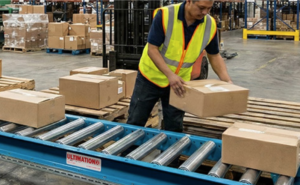
man using ultimation gravity conveyor

The Operational Limits of Gravity Conveyors

Gravity conveyors are simple and dependable, but they have limitations. They rely on manual pushing and repositioning, and they often lead to inconsistent flow and spacing between items, which in turn can create bottlenecks during peak seasons.

In many facilities, gravity systems depend on constant hands-on intervention. When loads are heavy or labor is tight, that becomes difficult to sustain. The physical strain of pushing product — sometimes hundreds of pounds at a time — can also raise ergonomic and safety concerns.

By contrast, MDR systems address the most common pain points of gravity roller systems. Their benefits include:

  • Automating movement without requiring full belt or chain systems
  • Enabling controlled flow and zero-pressure accumulation
  • Reducing the need for constant manual intervention
  • Scaling throughput without scaling labor

Zero-pressure accumulation is especially important. Instead of allowing products to pile up or collide, MDR systems divide the conveyor into zones that only activate when product is present. That controlled flow reduces damage and creates a more predictable operation.

MDR systems can often be installed incrementally, at a comfortable and affordable pace, building automation into your existing footprint rather than replacing it wholesale.

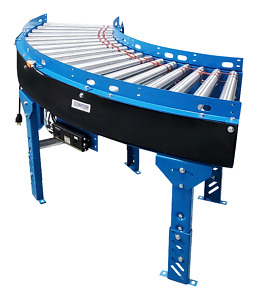
What a Gravity-to-MDR Automation Retrofit Looks LikeMDR Powered Roller Conveyor Curve 90 Degree

The retrofitting process typically starts with existing gravity conveyor frames. In many cases, those frames, rails, and floor layouts remain in place. Rather than tearing out entire lines, sections are converted zone by zone. Select rollers are replaced with motorized rollers, and low-voltage controls and power supplies are introduced to manage movement.

This approach adds in automation where it matters most, while preserving the structural investment already made in the system.

Let’s drill down a little bit into some of the key benefits of retrofitting to MDR:

  1. Reduced Dependence on Labor.

    During times when qualified staff can be in short supply, this is a big one. MDR systems require fewer people to keep product moving, while putting less physical strain on workers and helping maintain better consistency during labor shortages.

  2. Improved Throughput and Control.

    Zoned movement keeps product flowing predictably without manual oversight.

  3. Reduced Product Damage.

    MDR systems protect products through controlled starts and stops. Instead of chaotic pileups, items remain spaced and separated, even with mixed SKUs and varying weights.

  4. Improved Workplace Safety.

    Controlled automation reduces repetitive pushing and lowers ergonomic exposure on the floor.

Power Use vs. Performance Gains in Automation

It’s true that there’s a small tradeoff when it comes to energy consumption, because gravity systems don’t use power and MDR does.

However, MDR systems operate on low voltage and are designed to run only when product is present. They don’t draw continuous power the way traditional belt-driven systems do. In many applications, the incremental energy use is modest, especially when weighed against labor savings, lower damage rates, and improved uptime.

In most cases, the operational benefits outweigh the energy tradeoff.

Retrofitting Conveyor Systems in Active Facilities

Compared with full replacements, retrofit projects usually have a gentler impact because they require less teardown, involve fewer unknowns, and get operations back online faster.

Because existing frames and layouts are often preserved, there’s no need to remove stands or reconfigure entire sections of the facility. Retrofitting can be done in specific zones rather than across full lines, and installations can often be phased over nights or weekends. Gravity sections can remain operational during upgrades, reducing downtime.

Avoiding Common Conveyor Retrofit Automation Pitfalls

A successful retrofit benefits from expert guidance and input. Retrofitting is not simply a matter of swapping out rollers and plugging in power.

Challenges typically arise not from the technology itself, but from underestimating the planning required. These factors all affect performance:

  • Current conveyor roller specs
  • Current conveyor size
  • Product specs (material, weight, dimensions)
  • Torque requirements
  • Environmental conditions
  • Control complexity
  • Throughput (speed and volume)

In washdown environments or heavy-duty applications, for example, motor selection and component durability become especially important. Undersized motors, incorrect roller sizing, or mismatched controls can lead to costly rework.

Experience has shown that asking the right questions early on reduces troubleshooting later.

When Retrofitting a Conveyor Line May Not Be Right

Retrofitting from gravity to MDR makes sense in many situations, but it isn’t automatically the right answer for every facility. In some heavy-duty applications, load weights or torque requirements may push motor specifications higher than originally anticipated. If the existing frames are incompatible, significantly worn, or misaligned, the cost and effort required to adapt them may begin to approach that of a new system. In those cases, a broader redesign could deliver better long-term value.

Environmental factors can also influence the decision. Washdown conditions, extreme temperatures, or high-moisture environments may require specialized components that change the cost equation. And if a facility’s layout is due for major reconfiguration, retrofitting an existing footprint may not be the most strategic move.

The key is evaluation. A careful review of load profiles, structural condition, control needs, and long-term goals determine whether retrofit is the most practical solution or whether replacement makes more sense.

Retrofitting is powerful because it builds on what works. But the smartest decision is always the one that aligns with both operational needs and long-term plans.

Automation That Builds on What Works

The transition to MDR doesn’t have to mean abandoning your existing system. For many facilities, gravity conveyor frames provide a solid foundation for smarter, more controlled automation.

Retrofitting allows you to move toward automation at a comfortable pace, preserving infrastructure while improving performance, safety, and efficiency.

Ultimation’s team is ready to help you evaluate what makes sense for your facility, whether that’s a phased retrofit or a broader redesign for your conveyor systems.