New Video: How to Build an Overhead Conveyor

How to Build an Overhead Conveyor

Overhead conveyor installation

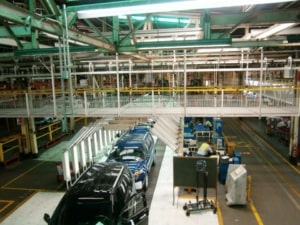
Overhead conveyors are great for many plants because they use the space above the production floor. Ultimation’s Alec Fitzgerald shows how companies can design and install their own Overhead Conveyor using the modular Unibilt System.


«The Ultimation and Jervis Webb Unibilt modular conveyor range is kind of like a LEGO set for overhead conveyors» says Ultimation Digital Marketing Supervisor, Alec Fitzgerald. «There is a huge range of pre-engineered components that can be joined together in a multitude of ways. Sometimes it’s easier to show this in a video, so we made this three minute segment to show you how.»

Fitzgerald says that many of his customers are able to design and install their own system once they have a good understanding of the components that are necessary and what is required to install them. «The Unibilt system is limited only by the imagination of the team working out the plan. So in addition to the layout that might come from the customer, we normally have some of our Ultimation specialists add some of their ideas as well» he said.

After the customer outlines the path their conveyor will follow, the Ultimation team creates a complete Bill of Materials (BOM) for the project. This BOM includes every component required for a full Unibilt installation, giving teams a clear, organized parts list to work from. Many companies then choose to have their own maintenance crews handle the installation using this detailed guide.


Take the Heavy Lifting Out of Palletizing with Automated Systems

Anytime you can remove a bottleneck in your warehouse or fulfillment center operations, that’s a win. Enter palletizers, which speed up one of the stages where slowdowns are most likely to occur.

Think of them as a lubricant for pallet-loading and -stacking.

In addition to being a labor-intensive process, manual pallet loading can also lead to inefficiencies, including inconsistent and poorly balanced pallet loads. Improperly stacked boxes can further increase the risk of product damage and workplace accidents.

Manual pallet-loading also can lead to repetitive motion injuries for workers. At a time when labor costs are rising and qualified employees are difficult to find, manual palletizing consumes valuable time and resources that could be better spent on higher-value tasks requiring human expertise.

Automated palletizers address these challenges by increasing efficiency, producing stable and uniform pallet loads, maximizing available warehouse space, and reducing the physical demands placed on your workforce.

Automated Palletizers: How Does It Work?

Automated palletizers use smart technology to optimize pallet stacking by determining optimal layer patterns based on each product’s size and dimensions. They quickly and efficiently load boxes onto each pallet, rotating them as necessary. This not only saves time, but helps make sure that pallet patterns are consistent.


Here’s what the workflow looks like with a Qimarox HR9 Palletizer:

  1. When new products arrive at your facility, team members load them onto a conveyor.
  2. As products travel along the conveyor, a 3D scanner scans the box dimensions.
  3. A pattern generator calculates all possible patterns and suggests the ideal arrangement for the pallet, based on the optimal number of boxes per layer and overall stability.
  4. As boxes arrive at the palletizer, they’re automatically arranged on the pallet.
  5. Palletizers can be combined with a pallet lift and conveyor system, so that each full pallet is stacked and then automatically replaced by an empty one for a smooth and continuous process.
  6. Products can be secured on the pallet as needed, at which point they’re ready for transport via forklift.
  7. When the container is empty and the last full pallet has been loaded, any remaining products can be stacked on an incomplete pallet.

Benefits That Stack Up

State-of-the-art palletizers are cost-efficient, and designed for high-throughput, safe product handling. Benefits include:

  • Smoother workflow: Palletizers automate the palletizing process from A to Z, starting with infeed and moving through to dispatch.
  • More consistent load quality: Palletizers create uniform load patterns with better stability, which reduces product damage during storage and transportation.
  • Boosted throughput: Faster handling of products with more stable and consistent pallet loads helps operations keep pace with accelerating production demands.
  • Improved workplace safety: Palletizers minimize repetitive lifting and bending, which reduces the risk of musculoskeletal injuries and creates a safer end-of-line environment.
  • Labor efficiency: Reduced dependence on manual stacking not only means less stress on team members — it leads to improved workforce utilization by freeing up employees to make better use of their time and talents. It also reduces error rates and boosts operational predictability.

Palletizers have payoffs across industries.

  • Manufacturers: finished goods handling and production line automation
  • Distributors: high-volume order fulfillment and improved shipping preparation
  • Consumer goods: mixed-product handling
  • Food and beverage: high-throughput packaging environments
  • Refrigerated and frozen foods: shorten transportation times, helping to prevent defrosting and maintain the quality of products

What Sets Qimarox Palletizers Apart

Ultimation offers high-capacity Qimarox palletizers for:

  • Automated product handling. Qimarox’s patented programmable pattern-forming method positions products at exact coordinates to optimize storage and vehicle space.
  • Smarter positioning. Products are arranged on pallets with ideal spacing to absorb bulging and help prevent damage. That ensures fully loaded pallets are not just stable, but solid, as well.
  • Flexible pallet pattern creation. The Qimarox Highrunner HR9 lets you choose between automatically generating the most suitable layer patterns for your products or selecting your own preferred layout.
  • Qimarox palletizers are designed to handle different package sizes and product types.
  • Superior product handling. Qimarox palletizers not only stack products securely and consistently, they slide products without manual or robotic lifting to minimize damage.
  • Easier maintenance. Qimarox technology facilitates the work of mechanics, with built-in camera systems that help quickly identify and resolve issues.
  • For growing operations, Qimarox palletizing solutions scale up to take on new challenges as needed.

When to Consider a Palletizer for Your Operations

If you’re experiencing any of the signs below, your operation may be ready for an automated palletizer:

  • Increasing order volumes. Do you need to increase your throughput to keep up with demand?
  • Frequent bottlenecks. Does your production line frequently slow down at the palletizing stage?
  • Labor concerns. Are you facing rising labor costs, or difficulty recruiting and hiring warehouse workers at the right level of skill and experience?
  • Safety issues. Are you seeing increased injuries, stress, and fatigue among team members because of manual handling?

How to Choose the Right Palletizing Solution

Here are four key criteria to consider that can point you in the right direction.

  1. Throughput requirements. What’s the volume of products you’re currently handling? How much does your capacity need to increase?
  2. Product characteristics. How variable are the products in your warehouse in terms of weight and dimensions? What special requirements do they have? How important is processing speed?
  3. Facility space constraints. How limited is your floor space, and are you making the best possible use of it? Would your operations benefit from a more efficient production layout?
  4. Future growth. What opportunities do you need to be ready for? What possibilities can increased throughput and better use of resources like space and labor unlock for your business?

The right palletizing solution can transform your operations, making them more flexible and adaptable in addition to boosting safety, efficiency, and throughput.

Interested in learning more about Qimarox palletizing solutions? Get in touch with our team.

How Spring-Assisted Lift Gates Remove Barriers to Productivity

Looking to safely improve warehouse efficiency? Learn how spring-assisted…

Do More With Your Warehouse Space with Powered Flexible Expandable Conveyors

Both time and space are at a premium in warehouse facilities.

That’s why flexible expandable conveyors are a valuable solution. Like a sofa that pulls out, flexible expandable conveyors expand when you need them and compact when you don’t. This adaptability makes them a cost-effective way to streamline assembly, packing, shipping, and receiving — especially for warehouses that deal with a lot of cross-docking, loading, and unloading.

But as useful as traditional gravity-based flexible expandable conveyors already are, there’s a way to make them even better: power. The powered version of flexible expandable conveyors delivers benefits that can reduce labor while simultaneously boosting efficiency and throughput.

How Adding Power Multiplies FlexibilityULTIMATION Powered Flex Conveyor

Powered flexible expandable conveyors are designed to adapt to your operation in real time.

  • Expands from 3 to 12 feet
  • Bends easily around obstacles and tight spaces
  • Connects seamlessly with additional conveyor units
  • Mounted on casters for easy mobility and positioning

This flexibility allows you to position one end near storage racks and the other at a truck or van for efficient loading and unloading. You can also use them to move products directly from one truck to another.

Because they’re compact when collapsed and quick to deploy, these conveyors can be rolled into place as soon as shipments arrive and then stored away when not in use.

Traditional gravity conveyors still require manual effort and often depend on an incline, making them more labor-intensive. By contrast, powered versions don’t require an incline so they can be deployed anywhere on your floor. Simply roll them into position, plug them in, and let them move product automatically – reducing effort, increasing speed, and improving overall efficiency.

Gravity vs. Powered Conveyors

The advantages of powered flexible expandable conveyors include:

  1. Ease of Use. Powered flexible expandable conveyors feature simple deployment; it only takes one person to set up a conveyor and move it into position. Operating them is similarly easy, with minimal manual handling.
  2. Reduced Labor. That ease of use means that one person can do the same work as three to four people using a gravity conveyor, which multiplies productivity.
  3. Better Ergonomics. By reducing the effort needed, powered flexible expandable conveyors reduce the risk of injury to workers, while also promoting more efficient handling and less chance of damage to products.
  4. Increased Throughput. With more efficient loading and unloading, powered flexible expandable conveyors move more product with less effort, which increases productivity.

A Smaller Footprint

The ability to scale up and scale down in response to changing circumstances has never been more important than it is today. With ongoing labor shortages and rising costs, warehouses are under pressure to do more with fewer workers.

Any innovation that provides warehouses with a way to adapt quickly and efficiently is a boon. Adding power to flexible expandable conveyors means you can get more out of your available warehouse space, without increasing the footprint.

Ready to reduce labor and increase throughput? Contact the team at Ultimation, an MCE company, to speak with a conveyor expert or request a quote.

How VectoRollers™ Boost Efficiency and Reduce Friction to Create a Flexible Flow in the Warehouse

Some ideas are so good for flow, they seem inevitable in retrospect. This is especially true if they apply a little out-of-the-box creative thinking to a long-standing pain point

— like luggage with wheels or self-sealing envelopes.

VectoRollers Installed in Gravity Conveyor

For warehouse conveyor systems, VectoRollers™ are a great example of this kind of design breakthrough. It provides an easy, affordable way to minimize the friction that arises when workers need to move products laterally, against the main direction of the conveyor.

By incorporating mini-rollers that run perpendicular to the conveyor’s main direction, VectoRollers™ allow items to easily slide in a lateral direction.

In fact, the VectoRoller™ lateral conveyor design reduces up to 80% the amount of force that’s needed to move packages laterally, compared with regular conveyor systems.

That ergonomic improvement means less strain and fatigue for operators, while allowing packages and products to go with the flow, instead of struggling against it.

The Trouble with Conventional Conveyors for Lateral Movement

Most warehouse conveyors are designed to move product efficiently along a straight line in a single direction. But warehouse reality isn’t always linear. There are times when products need to be intercepted and moved laterally such as at packing stations, quality control checks, and other secondary processes. Items may also need to be repositioned to align with scanners or other equipment.

Traditional conveyor rollers offer significant resistance to sideways movement, making the process harder than it needs to be. Generally, this means extra effort is required at pick, merge, and sorting points.

For warehouse workers, trying to move product against the main flow can be like swimming against a current. Lifting, pushing, or pulling products to move them laterally causes strain, fatigue, and stress. In addition to causing a slowdown in momentum and creating a drag on productivity, this can raise the risk of damage to products and injury to employees.

The impact is magnified given the speed at which modern warehouses need to move, due to higher volumes, mounting competition, and increased demands from customers — as well as the challenges of recruiting and retaining qualified team members in times of labor scarcity.

Why Some Lateral Conveyor Solutions Fall Short

In the past, warehouses have commonly used one of two different approaches for moving products in a lateral direction. But both methods come with drawbacks.

1. A ball transfer table (or ball transfer unit system) is a material-handling surface made up of many small, load-bearing balls that are mounted inside larger housings. Each unit contains a large main ball that sits on smaller support bearings, which allow it to rotate freely in any direction.

The catch is that this approach works best with rigid, flat-bottomed products. It’s less effective for packages with soft undersides or uneven surfaces, and very small items can be problematic as well.

Ball transfer tables are also vulnerable to dirt and debris, which can adversely affect performance. And it’s less than ideal when you need a controlled directional flow, since it allows items to move in any direction rather than just one specified counter-direction.

2. A pop-up transfer station consists of a powered conveyor mechanism that’s used to move products from one conveyor line to another, either at a right angle or moving in a different direction. These are often used in automated sorting systems, for diverting products to different lines, or when changing directions in high-throughput systems.

The main issue here is cost, because pop-up transfer stations tend to be expensive. And they still don’t provide the degree of ease and flexibility that’s needed to boost productivity and keep up with demand.

Rugged and Ready to Roll: VectoRollers™ Are Retrofit-Friendly and Built to Last

That’s where VectoRollers™ come in. Their perpendicular mini-rollers provide ease of lateral movement by rotating in the direction of travel, minimizing the resistance between the roller contact surface and the package in motion. And their proprietary wheels can be mounted at rates of up to two wheels per inch of effective tube width, to optimize the reduction in friction for a specific application.

Watch now: VectoRoller™ in Action


But despite the revolutionary benefits they deliver, VectoRollers™ don’t require a radical investment. In fact, they’re designed for easy, retrofit-ready installation, with no structural changes to conveyors required.

This makes them:

  • Cost-effective and budget-friendly. You can get all the benefits of VectoRollers™ without the need to install new conveyor equipment. And they’re scalable, too. Just swap them in as a replacement for existing rollers, whether gravity-based or powered, upgrading on your own timetable.
  • Easy to maintain. VectoRollers™ are customizable to include different groove profiles, which allows VectoRollers™ to play well with existing systems. Configurations are available for gravity, O-ring, poly-rib, and belt-driven live roller (BDLR) applications. And their 7/16” spring-retained hex axle optimizes ease of installation.
  • Built to be strong. They have a triple-layer coating that provides corrosion resistance, as well as superior cosmetics. And VectoRollers™ feature precision bearings for increased load capacity, speed, and durability, which maximizes their longevity in high-performance applications and settings.

Ultimation’s team of experts is ready to help you take advantage of the latest innovations that can boost warehouse efficiency and productivity. Get in touch to discuss the possibilities.

Subscribe to the Ultimation Newsletter