When Does a Ball Sorter Make Sense? Choosing the Right Solution for Flexible Product Transfers

One of the biggest conveyor design challenges is deciding where the conveyors need to go next.

Whether routing cartons to different packing stations, shipping lanes, or production cells, transfer points are often where congestion, maintenance demands, and the need for future flexibility become most apparent.

Ball sorters solve that by using powered transfer balls to provide flexible, multi-directional transfers within a compact footprint. Unlike fixed-angle transfers or pop-up diverters, the system can route products to multiple destinations from a single zone.

Using motorized roller technology instead of pneumatic actuators eliminates compressed air requirements and enables precise, programmable movement.

Ball sorters are commonly used to:

  • Route orders to multiple packing stations
  • Divert cartons by shipping carrier or destination
  • Feed multiple production or assembly lines
  • Consolidate products before palletizing
  • Direct totes to different fulfillment zones

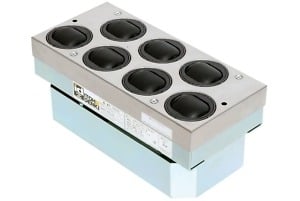
Itoh Denki Multi-Angle Ball Sorter (MABS2) Conveyor Sortation ModuleOne example is the Itoh Denki Multi Angle Ball Sorter (MABS2), available from Ultimation, an MCE company. The modular system uses the company’s 24V motor-driven roller (MDR) technology instead of pneumatic diverters to create programmable, multi-angle product transfers. Modules can be combined to accommodate larger products or higher throughput, making it easier to add flexible routing capabilities within a compact footprint while allowing conveyor systems to expand or adapt as operational requirements evolve.

When a Ball Sorter Is a Good Fit

Ball sorters are most valuable when versatility is more important than maximum throughput.

Multi-directional routing

Some applications require products to travel to several downstream destinations. Instead of designing multiple dedicated transfer points, one ball sorter can route products in different directions based on system logic. This simplifies conveyor layouts while making future changes easier.

Limited floor space

Facilities often need to add functionality within an existing footprint. Because ball sorters combine multiple routing capabilities into a compact module, they can help maximize available space without requiring extensive conveyor modifications.

Layouts expected to change

New customers, seasonal demand, changing product mixes, and additional fulfillment channels can all change material flow. Flexible routing allows conveyor systems to adapt without requiring major mechanical changes.

For example, an ecommerce fulfillment center may initially route cartons to four packing stations. As order volume grows, additional packing lanes are added and shipping workflows change. A modular ball sorter allows routing logic to be updated and additional transfer modules incorporated without redesigning the entire conveyor layout.

Continuous product flow

Stopping products before transferring them can create small delays that add up over thousands of packages. Ball sorters maintain continuous movement through the transfer process, reducing interruptions while supporting smooth product flow.


When a Ball Sorter May Not Be the Right Choice

In some situations, a different solution may deliver better performance or a lower total cost.

Simple point-to-point transfers

If products only need to move from one conveyor to another at a fixed angle, a traditional transfer or pop-up diverter may provide the same functionality with less complexity.

High-throughput applications

Facilities moving high volumes through a consistent, repeatable routing pattern may benefit from sortation technologies designed for maximum throughput. Ball sorters prioritize routing flexibility over sorting speed.

Products that don’t transfer well

Ball sorters perform best with products that have a stable, relatively flat conveying surface. Very small items, irregularly shaped products, or loads with unstable bottoms may require alternative transfer methods to maintain reliable movement.

Applications with little expected change

If routing paths are unlikely to change throughout the life of the system, investing in a highly flexible transfer solution may provide capabilities that are never fully utilized. Fixed routing solutions can sometimes offer a more economical approach for stable production environments.

The best transfer technology depends on the products being conveyed, required throughput, available space, and how much flexibility the operation is likely to need in the future.

Questions to Ask Before Selecting a Ball Sorter

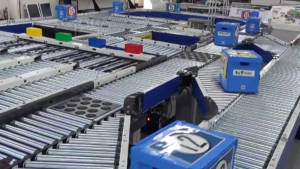
multiple mabs2 used in conveyor lines

Like any automation investment, selecting the right transfer technology begins with understanding the application. Ask:

  • How many destinations will products reach?
  • Will routing requirements change over time?
  • Is floor space limited?
  • Are compressed air systems already available, or would eliminating them simplify maintenance?
  • What product sizes, weights, and package characteristics will be conveyed?
  • What throughput is required today, and what will it likely be in five years?

As fulfillment operations evolve, conveyor systems need to evolve with them. Transfer technology should support changing product flows rather than lock facilities into fixed routing paths.

Need help determining whether a ball sorter is the right fit for your application?
The material handling experts at Ultimation can evaluate your product flow, routing requirements, and available space to help you select the right transfer solution. Contact us to discuss your application or learn more about the Itoh Denki Multi Angle Ball Sorter.

New Video: How to Build an Overhead Conveyor

How to Build an Overhead Conveyor

Overhead conveyor installation

Overhead conveyors are great for many plants because they use the space above the production floor. Ultimation’s Alec Fitzgerald shows how companies can design and install their own Overhead Conveyor using the modular Unibilt System.


“The Ultimation and Jervis Webb Unibilt modular conveyor range is kind of like a LEGO set for overhead conveyors” says Ultimation Digital Marketing Supervisor, Alec Fitzgerald. “There is a huge range of pre-engineered components that can be joined together in a multitude of ways. Sometimes it’s easier to show this in a video, so we made this three minute segment to show you how.”

Fitzgerald says that many of his customers are able to design and install their own system once they have a good understanding of the components that are necessary and what is required to install them. “The Unibilt system is limited only by the imagination of the team working out the plan. So in addition to the layout that might come from the customer, we normally have some of our Ultimation specialists add some of their ideas as well” he said.

After the customer outlines the path their conveyor will follow, the Ultimation team creates a complete Bill of Materials (BOM) for the project. This BOM includes every component required for a full Unibilt installation, giving teams a clear, organized parts list to work from. Many companies then choose to have their own maintenance crews handle the installation using this detailed guide.


Take the Heavy Lifting Out of Palletizing with Automated Systems

Anytime you can remove a bottleneck in your warehouse or fulfillment center operations, that’s a win. Enter palletizers, which speed up one of the stages where slowdowns are most likely to occur.

Think of them as a lubricant for pallet-loading and -stacking.

In addition to being a labor-intensive process, manual pallet loading can also lead to inefficiencies, including inconsistent and poorly balanced pallet loads. Improperly stacked boxes can further increase the risk of product damage and workplace accidents.

Manual pallet-loading also can lead to repetitive motion injuries for workers. At a time when labor costs are rising and qualified employees are difficult to find, manual palletizing consumes valuable time and resources that could be better spent on higher-value tasks requiring human expertise.

Automated palletizers address these challenges by increasing efficiency, producing stable and uniform pallet loads, maximizing available warehouse space, and reducing the physical demands placed on your workforce.

Automated Palletizers: How Does It Work?

Automated palletizers use smart technology to optimize pallet stacking by determining optimal layer patterns based on each product’s size and dimensions. They quickly and efficiently load boxes onto each pallet, rotating them as necessary. This not only saves time, but helps make sure that pallet patterns are consistent.


Here’s what the workflow looks like with a Qimarox HR9 Palletizer:

  1. When new products arrive at your facility, team members load them onto a conveyor.
  2. As products travel along the conveyor, a 3D scanner scans the box dimensions.
  3. A pattern generator calculates all possible patterns and suggests the ideal arrangement for the pallet, based on the optimal number of boxes per layer and overall stability.
  4. As boxes arrive at the palletizer, they’re automatically arranged on the pallet.
  5. Palletizers can be combined with a pallet lift and conveyor system, so that each full pallet is stacked and then automatically replaced by an empty one for a smooth and continuous process.
  6. Products can be secured on the pallet as needed, at which point they’re ready for transport via forklift.
  7. When the container is empty and the last full pallet has been loaded, any remaining products can be stacked on an incomplete pallet.

Benefits That Stack Up

State-of-the-art palletizers are cost-efficient, and designed for high-throughput, safe product handling. Benefits include:

  • Smoother workflow: Palletizers automate the palletizing process from A to Z, starting with infeed and moving through to dispatch.
  • More consistent load quality: Palletizers create uniform load patterns with better stability, which reduces product damage during storage and transportation.
  • Boosted throughput: Faster handling of products with more stable and consistent pallet loads helps operations keep pace with accelerating production demands.
  • Improved workplace safety: Palletizers minimize repetitive lifting and bending, which reduces the risk of musculoskeletal injuries and creates a safer end-of-line environment.
  • Labor efficiency: Reduced dependence on manual stacking not only means less stress on team members — it leads to improved workforce utilization by freeing up employees to make better use of their time and talents. It also reduces error rates and boosts operational predictability.

Palletizers have payoffs across industries.

  • Manufacturers: finished goods handling and production line automation
  • Distributors: high-volume order fulfillment and improved shipping preparation
  • Consumer goods: mixed-product handling
  • Food and beverage: high-throughput packaging environments
  • Refrigerated and frozen foods: shorten transportation times, helping to prevent defrosting and maintain the quality of products

What Sets Qimarox Palletizers Apart

Ultimation offers high-capacity Qimarox palletizers for:

  • Automated product handling. Qimarox’s patented programmable pattern-forming method positions products at exact coordinates to optimize storage and vehicle space.
  • Smarter positioning. Products are arranged on pallets with ideal spacing to absorb bulging and help prevent damage. That ensures fully loaded pallets are not just stable, but solid, as well.
  • Flexible pallet pattern creation. The Qimarox Highrunner HR9 lets you choose between automatically generating the most suitable layer patterns for your products or selecting your own preferred layout.
  • Qimarox palletizers are designed to handle different package sizes and product types.
  • Superior product handling. Qimarox palletizers not only stack products securely and consistently, they slide products without manual or robotic lifting to minimize damage.
  • Easier maintenance. Qimarox technology facilitates the work of mechanics, with built-in camera systems that help quickly identify and resolve issues.
  • For growing operations, Qimarox palletizing solutions scale up to take on new challenges as needed.

When to Consider a Palletizer for Your Operations

If you’re experiencing any of the signs below, your operation may be ready for an automated palletizer:

  • Increasing order volumes. Do you need to increase your throughput to keep up with demand?
  • Frequent bottlenecks. Does your production line frequently slow down at the palletizing stage?
  • Labor concerns. Are you facing rising labor costs, or difficulty recruiting and hiring warehouse workers at the right level of skill and experience?
  • Safety issues. Are you seeing increased injuries, stress, and fatigue among team members because of manual handling?

How to Choose the Right Palletizing Solution

Here are four key criteria to consider that can point you in the right direction.

  1. Throughput requirements. What’s the volume of products you’re currently handling? How much does your capacity need to increase?
  2. Product characteristics. How variable are the products in your warehouse in terms of weight and dimensions? What special requirements do they have? How important is processing speed?
  3. Facility space constraints. How limited is your floor space, and are you making the best possible use of it? Would your operations benefit from a more efficient production layout?
  4. Future growth. What opportunities do you need to be ready for? What possibilities can increased throughput and better use of resources like space and labor unlock for your business?

The right palletizing solution can transform your operations, making them more flexible and adaptable in addition to boosting safety, efficiency, and throughput.

Interested in learning more about Qimarox palletizing solutions? Get in touch with our team.

How Spring-Assisted Lift Gates Remove Barriers to Productivity

Looking to safely improve warehouse efficiency? Learn how spring-assisted…

Do More With Your Warehouse Space with Powered Flexible Expandable Conveyors

Both time and space are at a premium in warehouse facilities.

That’s why flexible expandable conveyors are a valuable solution. Like a sofa that pulls out, flexible expandable conveyors expand when you need them and compact when you don’t. This adaptability makes them a cost-effective way to streamline assembly, packing, shipping, and receiving — especially for warehouses that deal with a lot of cross-docking, loading, and unloading.

But as useful as traditional gravity-based flexible expandable conveyors already are, there’s a way to make them even better: power. The powered version of flexible expandable conveyors delivers benefits that can reduce labor while simultaneously boosting efficiency and throughput.

How Adding Power Multiplies FlexibilityULTIMATION Powered Flex Conveyor

Powered flexible expandable conveyors are designed to adapt to your operation in real time.

  • Expands from 3 to 12 feet
  • Bends easily around obstacles and tight spaces
  • Connects seamlessly with additional conveyor units
  • Mounted on casters for easy mobility and positioning

This flexibility allows you to position one end near storage racks and the other at a truck or van for efficient loading and unloading. You can also use them to move products directly from one truck to another.

Because they’re compact when collapsed and quick to deploy, these conveyors can be rolled into place as soon as shipments arrive and then stored away when not in use.

Traditional gravity conveyors still require manual effort and often depend on an incline, making them more labor-intensive. By contrast, powered versions don’t require an incline so they can be deployed anywhere on your floor. Simply roll them into position, plug them in, and let them move product automatically – reducing effort, increasing speed, and improving overall efficiency.

Gravity vs. Powered Conveyors

The advantages of powered flexible expandable conveyors include:

  1. Ease of Use. Powered flexible expandable conveyors feature simple deployment; it only takes one person to set up a conveyor and move it into position. Operating them is similarly easy, with minimal manual handling.
  2. Reduced Labor. That ease of use means that one person can do the same work as three to four people using a gravity conveyor, which multiplies productivity.
  3. Better Ergonomics. By reducing the effort needed, powered flexible expandable conveyors reduce the risk of injury to workers, while also promoting more efficient handling and less chance of damage to products.
  4. Increased Throughput. With more efficient loading and unloading, powered flexible expandable conveyors move more product with less effort, which increases productivity.

A Smaller Footprint

The ability to scale up and scale down in response to changing circumstances has never been more important than it is today. With ongoing labor shortages and rising costs, warehouses are under pressure to do more with fewer workers.

Any innovation that provides warehouses with a way to adapt quickly and efficiently is a boon. Adding power to flexible expandable conveyors means you can get more out of your available warehouse space, without increasing the footprint.

Ready to reduce labor and increase throughput? Contact the team at Ultimation, an MCE company, to speak with a conveyor expert or request a quote.