How VectoRollers Boost Efficiency and Reduce Friction to Create a Flexible Flow in the Warehouse

Some ideas are so good for flow, they seem inevitable in retrospect. This is especially true if they apply a little out-of-the-box creative thinking to a long-standing pain point

— like luggage with wheels or self-sealing envelopes.

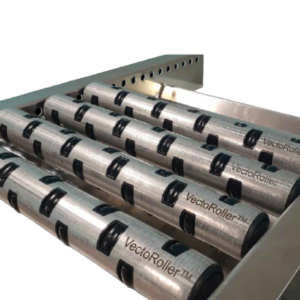
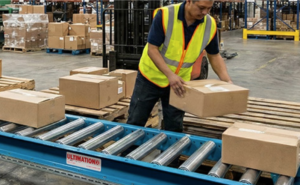
VectoRollers Installed in Gravity Conveyor

For warehouse conveyor systems, VectoRollers are a great example of this kind of design breakthrough. It provides an easy, affordable way to minimize the friction that arises when workers need to move products laterally, against the main direction of the conveyor.

By incorporating mini-rollers that run perpendicular to the conveyor’s main direction, VectoRollers allow items to easily slide in a lateral direction.

In fact, the VectoRoller lateral conveyor design reduces up to 80% the amount of force that’s needed to move packages laterally, compared with regular conveyor systems.

That ergonomic improvement means less strain and fatigue for operators, while allowing packages and products to go with the flow, instead of struggling against it.

The Trouble with Conventional Conveyors for Lateral Movement

Most warehouse conveyors are designed to move product efficiently along a straight line in a single direction. But warehouse reality isn’t always linear. There are times when products need to be intercepted and moved laterally such as at packing stations, quality control checks, and other secondary processes. Items may also need to be repositioned to align with scanners or other equipment.

Traditional conveyor rollers offer significant resistance to sideways movement, making the process harder than it needs to be. Generally, this means extra effort is required at pick, merge, and sorting points.

For warehouse workers, trying to move product against the main flow can be like swimming against a current. Lifting, pushing, or pulling products to move them laterally causes strain, fatigue, and stress. In addition to causing a slowdown in momentum and creating a drag on productivity, this can raise the risk of damage to products and injury to employees.

The impact is magnified given the speed at which modern warehouses need to move, due to higher volumes, mounting competition, and increased demands from customers — as well as the challenges of recruiting and retaining qualified team members in times of labor scarcity.

Why Some Lateral Conveyor Solutions Fall Short

In the past, warehouses have commonly used one of two different approaches for moving products in a lateral direction. But both methods come with drawbacks.

1. A ball transfer table (or ball transfer unit system) is a material-handling surface made up of many small, load-bearing balls that are mounted inside larger housings. Each unit contains a large main ball that sits on smaller support bearings, which allow it to rotate freely in any direction.

The catch is that this approach works best with rigid, flat-bottomed products. It’s less effective for packages with soft undersides or uneven surfaces, and very small items can be problematic as well.

Ball transfer tables are also vulnerable to dirt and debris, which can adversely affect performance. And it’s less than ideal when you need a controlled directional flow, since it allows items to move in any direction rather than just one specified counter-direction.

2. A pop-up transfer station consists of a powered conveyor mechanism that’s used to move products from one conveyor line to another, either at a right angle or moving in a different direction. These are often used in automated sorting systems, for diverting products to different lines, or when changing directions in high-throughput systems.

The main issue here is cost, because pop-up transfer stations tend to be expensive. And they still don’t provide the degree of ease and flexibility that’s needed to boost productivity and keep up with demand.

Rugged and Ready to Roll: VectoRollers Are Retrofit-Friendly and Built to Last

That’s where VectoRollers come in. Their perpendicular mini-rollers provide ease of lateral movement by rotating in the direction of travel, minimizing the resistance between the roller contact surface and the package in motion. And their proprietary wheels can be mounted at rates of up to two wheels per inch of effective tube width, to optimize the reduction in friction for a specific application.

Watch now: VectoRoller in Action


But despite the revolutionary benefits they deliver, VectoRollers don’t require a radical investment. In fact, they’re designed for easy, retrofit-ready installation, with no structural changes to conveyors required.

This makes them:

  • Cost-effective and budget-friendly. You can get all the benefits of VectoRollers without the need to install new conveyor equipment. And they’re scalable, too. Just swap them in as a replacement for existing rollers, whether gravity-based or powered, upgrading on your own timetable.
  • Easy to maintain. VectoRollers are customizable to include different groove profiles, which allows VectoRollers to play well with existing systems. Configurations are available for gravity, O-ring, poly-rib, and belt-driven live roller (BDLR) applications. And their 7/16” spring-retained hex axle optimizes ease of installation.
  • Built to be strong. They have a triple-layer coating that provides corrosion resistance, as well as superior cosmetics. And VectoRollers feature precision bearings for increased load capacity, speed, and durability, which maximizes their longevity in high-performance applications and settings.

Ultimation’s team of experts is ready to help you take advantage of the latest innovations that can boost warehouse efficiency and productivity. Get in touch to discuss the possibilities.

Subscribe to the Ultimation Newsletter

Automate Conveyors Without Starting Over: The Case for Retrofitting to MDR

Many conveyor retrofit conversations start for practical reasons:

  • A key component fails and the repair cost forces a bigger question.
  • Or your current system simply can’t keep up with today’s throughput requirement, labor realities, or safety expectations.

At that point, the decision isn’t just about fixing what broke. It’s about whether to keep patching an aging gravity conveyor system or upgrade it intelligently.

Some of the most effective automation projects start by improving what’s already in place. Taking an incremental approach — by retrofitting existing systems — can deliver measurable rewards without starting over from scratch.

Gravity conveyors are an ideal candidate for retrofitting by upgrading to motor-driven roller (MDR) conveyors. MDR systems use small motors distributed throughout the system to drive the rollers. They’re compact, quiet, and safe. They provide fast, smooth movement with sensors and controls that prevent packages from crushing into one another. Benefits include energy efficiency, low noise, and relatively simple maintenance.

The payoffs for retrofitting a gravity conveyor to MDR include not just greater efficiency with less labor, but also reduced damage, improved control, and better workplace safety — all while preserving much of the infrastructure you already have.

man using ultimation gravity conveyor

The Operational Limits of Gravity Conveyors

Gravity conveyors are simple and dependable, but they have limitations. They rely on manual pushing and repositioning, and they often lead to inconsistent flow and spacing between items, which in turn can create bottlenecks during peak seasons.

In many facilities, gravity systems depend on constant hands-on intervention. When loads are heavy or labor is tight, that becomes difficult to sustain. The physical strain of pushing product — sometimes hundreds of pounds at a time — can also raise ergonomic and safety concerns.

By contrast, MDR systems address the most common pain points of gravity roller systems. Their benefits include:

  • Automating movement without requiring full belt or chain systems
  • Enabling controlled flow and zero-pressure accumulation
  • Reducing the need for constant manual intervention
  • Scaling throughput without scaling labor

Zero-pressure accumulation is especially important. Instead of allowing products to pile up or collide, MDR systems divide the conveyor into zones that only activate when product is present. That controlled flow reduces damage and creates a more predictable operation.

MDR systems can often be installed incrementally, at a comfortable and affordable pace, building automation into your existing footprint rather than replacing it wholesale.

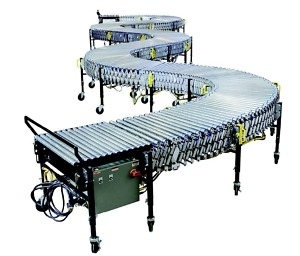
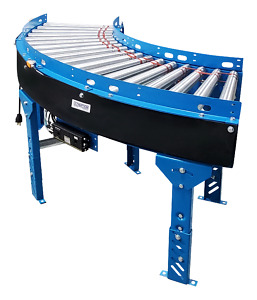
What a Gravity-to-MDR Automation Retrofit Looks LikeMDR Powered Roller Conveyor Curve 90 Degree

The retrofitting process typically starts with existing gravity conveyor frames. In many cases, those frames, rails, and floor layouts remain in place. Rather than tearing out entire lines, sections are converted zone by zone. Select rollers are replaced with motorized rollers, and low-voltage controls and power supplies are introduced to manage movement.

This approach adds in automation where it matters most, while preserving the structural investment already made in the system.

Let’s drill down a little bit into some of the key benefits of retrofitting to MDR:

  1. Reduced Dependence on Labor.

    During times when qualified staff can be in short supply, this is a big one. MDR systems require fewer people to keep product moving, while putting less physical strain on workers and helping maintain better consistency during labor shortages.

  2. Improved Throughput and Control.

    Zoned movement keeps product flowing predictably without manual oversight.

  3. Reduced Product Damage.

    MDR systems protect products through controlled starts and stops. Instead of chaotic pileups, items remain spaced and separated, even with mixed SKUs and varying weights.

  4. Improved Workplace Safety.

    Controlled automation reduces repetitive pushing and lowers ergonomic exposure on the floor.

Power Use vs. Performance Gains in Automation

It’s true that there’s a small tradeoff when it comes to energy consumption, because gravity systems don’t use power and MDR does.

However, MDR systems operate on low voltage and are designed to run only when product is present. They don’t draw continuous power the way traditional belt-driven systems do. In many applications, the incremental energy use is modest, especially when weighed against labor savings, lower damage rates, and improved uptime.

In most cases, the operational benefits outweigh the energy tradeoff.

Retrofitting Conveyor Systems in Active Facilities

Compared with full replacements, retrofit projects usually have a gentler impact because they require less teardown, involve fewer unknowns, and get operations back online faster.

Because existing frames and layouts are often preserved, there’s no need to remove stands or reconfigure entire sections of the facility. Retrofitting can be done in specific zones rather than across full lines, and installations can often be phased over nights or weekends. Gravity sections can remain operational during upgrades, reducing downtime.

Avoiding Common Conveyor Retrofit Automation Pitfalls

A successful retrofit benefits from expert guidance and input. Retrofitting is not simply a matter of swapping out rollers and plugging in power.

Challenges typically arise not from the technology itself, but from underestimating the planning required. These factors all affect performance:

  • Current conveyor roller specs
  • Current conveyor size
  • Product specs (material, weight, dimensions)
  • Torque requirements
  • Environmental conditions
  • Control complexity
  • Throughput (speed and volume)

In washdown environments or heavy-duty applications, for example, motor selection and component durability become especially important. Undersized motors, incorrect roller sizing, or mismatched controls can lead to costly rework.

Experience has shown that asking the right questions early on reduces troubleshooting later.

When Retrofitting a Conveyor Line May Not Be Right

Retrofitting from gravity to MDR makes sense in many situations, but it isn’t automatically the right answer for every facility. In some heavy-duty applications, load weights or torque requirements may push motor specifications higher than originally anticipated. If the existing frames are incompatible, significantly worn, or misaligned, the cost and effort required to adapt them may begin to approach that of a new system. In those cases, a broader redesign could deliver better long-term value.

Environmental factors can also influence the decision. Washdown conditions, extreme temperatures, or high-moisture environments may require specialized components that change the cost equation. And if a facility’s layout is due for major reconfiguration, retrofitting an existing footprint may not be the most strategic move.

The key is evaluation. A careful review of load profiles, structural condition, control needs, and long-term goals determine whether retrofit is the most practical solution or whether replacement makes more sense.

Retrofitting is powerful because it builds on what works. But the smartest decision is always the one that aligns with both operational needs and long-term plans.

Automation That Builds on What Works

The transition to MDR doesn’t have to mean abandoning your existing system. For many facilities, gravity conveyor frames provide a solid foundation for smarter, more controlled automation.

Retrofitting allows you to move toward automation at a comfortable pace, preserving infrastructure while improving performance, safety, and efficiency.

Ultimation’s team is ready to help you evaluate what makes sense for your facility, whether that’s a phased retrofit or a broader redesign for your conveyor systems.

Running Out of Space? Consider Overhead or Tiered Conveyors

One of the biggest challenges in warehousing is fitting everything into an existing facility as operations grow. Problems don’t show up all at once, but when they do, they start to affect safety and throughput.

Aisles narrow. Temporary staging areas turn permanent. Product travel paths stretch longer than they should. By the time teams label it a space problem, inefficiency has already become routine.

At that point, many facilities jump straight to expansion. However, unused vertical space often holds the solution. Overhead and tiered conveyors give warehouses a way to move product without expanding the footprint, keeping material flow off the floor while making better use of the existing space.

When Overhead or Tiered Conveyors Are the Right Fit

To determine whether overhead or tiered conveyors make sense for your facility, it’s important to evaluate several key factors.

1. Facility Footprint & Space Utilization

Tiered Overhead Conveyor in Facility

Most facilities begin to feel space constraints long before they officially run out of room. As operations grow, fixed equipment forces products to take longer, less efficient paths through the facility. A common response is to consider building out, but expansion comes with high costs, long timelines, and disruption to ongoing operations.

Overhead and tiered conveyors offer a different approach by using unused vertical space instead of expanding the footprint. By lifting material flow off the floor, these systems reduce congestion and support growth without altering the building itself.

Facilities should consider:

  • Available ceiling height and structural support
  • Areas where floor-level congestion affects safety or productivity
  • Whether material flow crosses walkways, aisles, or work cells
  • How future growth could impact space needs

Ultimation overhead and tiered conveyor systems build up, not out, and each unit is custom-fit to your facility rather than forcing layouts to adapt to standardized equipment. That flexibility allows teams to optimize their existing space before committing to the costs and disruption that come with a major construction project.

2. Labor, Safety & Workflow Efficiency

Manual material handling consumes significant time and labor. As workflows become more complex, training takes longer and turnover makes it harder to maintain consistency. At the same time, increased forklift traffic adds to floor congestion and raises safety risks.

Overhead and tiered conveyors reduce unnecessary handling without removing people from the process. By keeping materials moving automatically, these systems allow teams to spend less time repositioning product and more time focused on higher-value work.

Lifting material flow off the floor also reduces interactions between forklifts and pedestrians in high-traffic areas. Over time, facilities experience fewer bottlenecks, smoother workflows, and more consistent throughput. These improvements often lead to reduced overtime, lower injury risk, and improved employee satisfaction.

3. Product Protection & Noise Considerations

Not every product can withstand rough handling. Finished goods and packaged items are vulnerable to damage when vibration or uncontrolled accumulation is introduced into the process. Sensitive components face similar risks from impact during transport.

Overhead and tiered conveyors help reduce floor-level hazards that often contribute to product damage. Design features such as urethane- or rubber-coated rollers control movement while minimizing scuffing and slippage. Carefully managed conveyor speeds further protect products as they move through the system.

Noise levels also influence safety and efficiency on the plant floor. Traditional conveyor drives can generate sound levels that interfere with communication and situational awareness. Ultimation’s 24V DC conveyor systems operate at lower noise levels, supporting compliance while creating calmer work environments. Reduced noise improves communication and helps teams remain aware of surrounding activity.

When Overhead or Tiered Conveyors May Not Be the Right Fit

Overhead and tiered conveyors can solve meaningful material-handling challenges, but they are not the right solution for every facility. The key is understanding where they add value and where they may introduce new constraints.

Some operations handle loads that are too heavy, unstable, or difficult to secure for elevated conveying. Others face ceiling height limitations or overhead congestion that make routing impractical. In facilities where product flow paths change frequently, it can also be challenging to design a system that remains efficient over time.

Timing is another important consideration. If a facility is planning to relocate or undergo significant reconfiguration, it may be wise to pause and evaluate longer-term needs before investing in new equipment.

It’s worth stepping back before committing to any solution. Overhead and tiered conveyors deliver the best results when they are part of a broader material flow strategy, not when implemented as a standalone fix. A thoughtful evaluation helps ensure the system fits the space while supporting operational growth.

Ready for an Overhead Conveyor System? Questions to Ask Before You Decide

If your warehouses struggle with space challenges, ask yourself:

  • Do you have unused overhead space above production lines or walkways?
  • Are aisles or floor operations frequently congested?
  • Is your facility footprint maxed out while throughput demands continue to grow?
  • Does manual material handling consume labor you cannot afford to lose?
  • Do your products require gentler handling or quieter transport?
  • Do you want automation that fits your current building instead of forcing expansion?

The goal is to align your facility layout and workflow before making a major investment.

Overhead and tiered conveyors help many facilities grow without the need for traditional, costly expansion. When the fit is right, they improve flow and help teams make better use of the space they already own.

Ready to Evaluate Your Warehouse Space?

A feasibility discussion with the Ultimation team helps determine whether these systems will support your operation or whether another material-handling solution makes more sense. We’ll help you evaluate your options and determine the smartest path forward for your operation.

Talk with an Ultimation conveyor specialist to assess your facility and explore the right next step.